
Online Tutoring vs Home Tuition: Which Is Better for Students?
Choosing between online tutoring and home tuition can be difficult for parents who want the best academic support for their children. Both options can help students understand difficult concepts, complete homework, improve study habits, and prepare for examinations. However, the right choice depends on a student’s age, learning style, academic goals, family routine, and access to technology.
In Pakistan, parents often compare these options for students studying Matric, FSc, Cambridge O Levels, A Levels, IGCSE, Edexcel, IB, and AP programmes. Some students benefit from sitting with a tutor in person, while others learn comfortably through interactive online lessons.
So, when comparing online tutoring vs home tuition, which option is better?
The answer is that neither method is automatically superior. Online tutoring offers flexibility and access to tutors from different locations, whereas home tuition provides direct, face-to-face interaction. The best choice is the one that meets your child’s educational needs and allows consistent, focused learning.
In this guide, Oxford Home Tutors explains the differences between both options, their advantages and disadvantages, their suitability for different age groups, and how parents can make an informed decision.
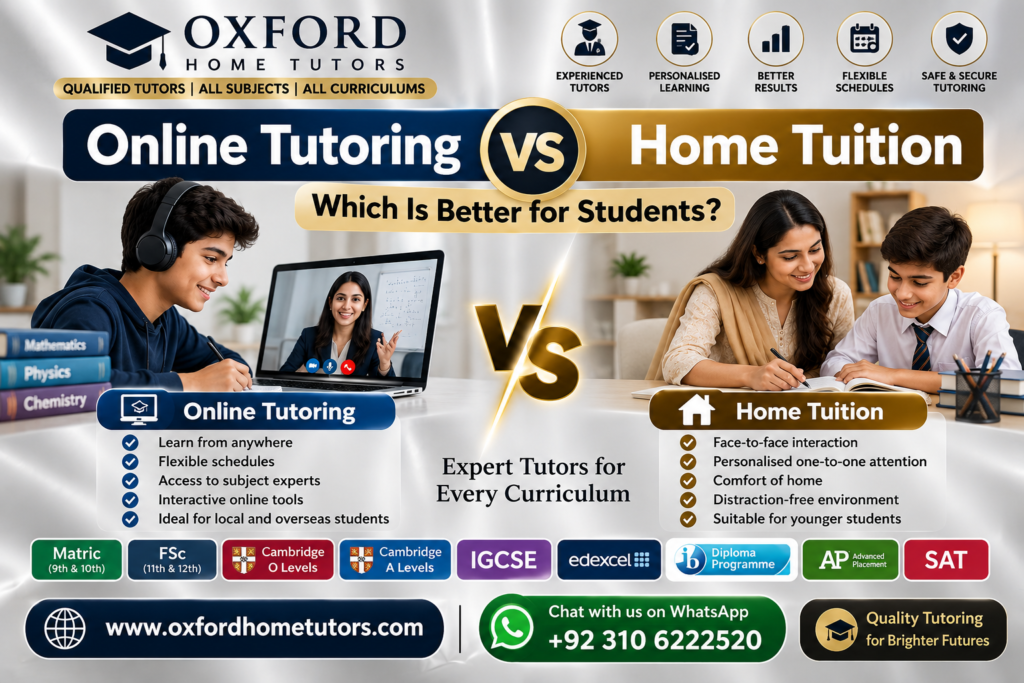
What Is Online Tutoring?
Online tutoring is a teaching arrangement in which a student learns from a tutor through the internet. Lessons usually take place through video calls, digital whiteboards, screen sharing, messaging, and online learning materials.
A student in Lahore, for example, can attend a live Mathematics lesson with a tutor based in another city without leaving home. Similarly, a Pakistani student living in the UAE, UK, USA, or Canada can receive online academic support from a tutor familiar with the student’s curriculum.
Online tutoring may include:
- One-to-one live lessons with a subject specialist.
- Small-group teaching, where offered.
- Digital worksheets, quizzes, and assignments.
- Online Mathematics problem-solving and science explanations.
- Past-paper practice and examination revision.
- Homework guidance and regular progress discussions.
The quality of an online lesson depends on the tutor’s subject knowledge, teaching methods, interaction with the student, and ability to assess understanding. A video call alone does not guarantee effective learning.
According to Cambridge International’s guidance on online education, online learning can provide flexibility, personalised support, and access to educational opportunities beyond a student’s immediate location.
What Is Home Tuition?
Home tuition is a form of private teaching in which a tutor visits the student’s home to provide face-to-face academic support. Lessons typically take place at a desk or in a quiet study area.
Many families in Lahore choose home tuition because it allows students to ask questions directly, work through written exercises with a tutor, and receive individual attention in a familiar environment.
Home tuition can support students studying:
- Primary and middle-school subjects.
- Matric and Intermediate, including FSc, ICS, and ICom.
- Cambridge O Levels, A Levels, and IGCSE.
- Pearson Edexcel qualifications.
- International Baccalaureate (IB) programmes.
- Advanced Placement (AP) subjects.
- Entry tests and other academic examinations.
A home tutor can observe how a student approaches a problem, identify recurring mistakes, and adapt the explanation during the lesson. For younger children or students who struggle to concentrate independently, this direct supervision may be particularly helpful.
Home tuition does, however, require coordination around the tutor’s travel, the family’s schedule, and a suitable teaching space.
Online Tutoring vs Home Tuition: Key Differences
The following comparison can help parents understand which arrangement is more suitable for their circumstances.
| Factor | Online tutoring | Home tuition |
|---|---|---|
| Learning environment | Virtual classroom or video call | Face-to-face at home |
| Convenience | No tutor travel required | Requires arranging a home visit |
| Tutor selection | Can access tutors from different locations | Often depends on local availability and travel distance |
| Personal attention | Available through one-to-one online lessons | Available through one-to-one face-to-face lessons |
| Technology | Requires a suitable device, internet, and basic digital skills | Usually requires fewer digital tools |
| Written practice | Digital whiteboards and shared documents, or paper alongside lessons | Direct paper-based work and demonstration |
| Supervision | Requires suitable online lesson routines | Easier to observe the lesson in person |
| Flexibility | Often convenient for remote or overseas families | Depends on tutor availability and travel |
| Social interaction | Primarily digital during the lesson | In-person interaction |
| Cost considerations | No tutor travel to the home | Travel and location may affect the fee |
| Best potential fit | Independent learners and families needing flexibility | Students who benefit from physical presence and direct supervision |
These are general differences, not guarantees. A skilled online tutor can provide excellent individual attention, and an in-person tutor may still be ineffective if lessons lack structure or clear learning goals.
Advantages of Online Tutoring
1. Learn from Almost Anywhere
One of the biggest advantages of online tutoring is that the student and tutor do not need to live in the same neighbourhood.
For example, a family in Bahria Town Lahore may prefer a subject specialist who lives elsewhere in the city. An online arrangement can make that tutor accessible without requiring regular travel.
It can also help overseas Pakistani families find academic support aligned with their child’s school curriculum.
2. Flexible Scheduling
Online lessons remove the need to coordinate a tutor’s journey to the student’s home. This can make scheduling more manageable for students who attend school, participate in extracurricular activities, or have demanding examination timetables.
However, flexibility still depends on the tutor’s availability and the agreed lesson schedule.
3. Access to Specialist Tutors
Some subjects require a particular type of expertise. A student preparing for AP Calculus, IB Physics, A Level Economics, or a specialised computer science examination may need a tutor with relevant subject knowledge.
Online tutoring expands the potential pool of tutors beyond the immediate local area.
Parents should still verify the tutor’s experience with the exact curriculum, subject level, and assessment requirements.
4. Digital Learning Resources
Online lessons can make it easy to share diagrams, presentations, worksheets, digital whiteboards, and practice questions.
For example, an A Level Mathematics tutor can work through a differentiation problem on a digital whiteboard while the student follows each step. A Physics tutor can annotate a diagram and share it for later revision.
These resources are useful when they support active learning rather than simply replacing teaching with long presentations.
5. Potential Savings on Travel
Online tutoring eliminates the tutor’s commute. Depending on the tutor’s fee structure, location, subject, and lesson duration, this may make online lessons more affordable.
However, online tutoring is not always cheaper. Specialist tutors may charge higher fees, and families may need to account for internet access, devices, or other learning requirements.
Challenges of Online Tutoring
Online lessons can be less effective when students lack a reliable internet connection, suitable equipment, or a quiet place to study.
Younger children may also need parental assistance with logging in, organising materials, and remaining focused.
To improve the experience:
- Use a laptop or tablet when possible, particularly for subjects involving diagrams or written calculations.
- Check the internet connection before lessons.
- Keep notebooks, textbooks, and stationery ready.
- Ask the tutor to include questions and exercises throughout the session.
- Arrange regular feedback so parents can understand the student’s progress.
For younger learners, parents should also consider appropriate online safety, privacy, and supervision.
Advantages of Home Tuition
1. Direct Face-to-Face Interaction
Some students communicate more comfortably when their tutor is physically present. They can ask questions, show their written work, and receive immediate explanations without navigating a digital classroom.
This may be especially useful for children who are new to private tutoring or who find online communication distracting.
2. Easier Supervision for Younger Students
Parents of primary-school children often want a tutor who can help establish a regular study routine.
During home tuition, the tutor can encourage the child to sit properly, organise books, complete written exercises, and work through mistakes step by step. Parents can also observe how the lesson is conducted, while respecting the tutor’s and child’s need for a focused learning environment.
Face-to-face teaching does not remove the need for parental communication or appropriate tutor screening.
3. Practical Support with Written Work
Home tuition can be useful when a student needs close guidance with handwriting, mathematical working, diagrams, or extended written answers.
For example, a Class 8 student struggling with algebra can solve questions in a notebook while the tutor observes each step. The tutor can identify whether the problem involves signs, fractions, equations, or a misunderstanding of the underlying concept.
Online tutors can provide similar support using digital tools, but some students find paper-based instruction more natural.
4. A Dedicated Study Routine
Having a tutor arrive at a fixed time can help some students develop a consistent academic routine. It also reduces the temptation to switch between lesson materials and unrelated websites during a session.
This benefit depends on the student’s habits and the quality of the teaching arrangement. A well-managed online lesson can be equally structured.
Challenges of Home Tuition
Home tuition has practical limitations that families should consider.
- Tutor availability: A suitable specialist may not be available in the family’s area.
- Travel delays: Traffic in Lahore can affect lesson timings, particularly during busy hours.
- Scheduling: Changes may require coordination between the tutor and family.
- Home arrangements: Families need a quiet, appropriate space for teaching.
- Potentially higher costs: Some tutors factor travel time and transport expenses into their fees.
Parents should also agree on lesson timings, attendance, payment terms, learning objectives, and communication expectations before tuition begins.
Which Option Is Better for Different Age Groups?
The student’s age can help determine which teaching arrangement is appropriate, but age alone should not decide the matter.
Primary School Students: Classes 1–5
For younger children, home tuition can be a strong option if they need help developing foundational skills in reading, writing, Mathematics, and English.
A tutor can guide them through short activities, monitor written work, and provide frequent encouragement.
Online tutoring can also work well when lessons are interactive, appropriately paced, and supported by a parent when necessary. A child who enjoys digital activities may respond positively to a well-designed online lesson.
Recommendation: Consider home tuition if your child needs close supervision. Consider online tutoring if your child can follow instructions, engage with the screen, and participate actively.
Middle School Students: Classes 6–8
Students in middle school begin studying more complex topics in Mathematics, Science, English, and other subjects. They also need to develop independent study habits.
Both online and home tuition can be effective at this stage.
A student who struggles with algebra or basic Physics concepts may benefit from direct guidance. Another student who works independently and needs help with selected topics may prefer online lessons.
Recommendation: Choose the format that helps your child practise regularly, ask questions, and complete work independently between lessons.
Matric and Intermediate Students
Students preparing for Matric, FSc, ICS, or ICom often need structured revision, conceptual understanding, and practice with examination-style questions.
Online tutoring can be convenient for subject-specific support and revision. Home tuition may suit students who benefit from close monitoring of written practice and regular study routines.
For these students, the tutor’s familiarity with the relevant Pakistani board and syllabus is more important than whether the lesson takes place online or in person.
Recommendation: Prioritise a tutor who understands your child’s examination board, identifies weak topics, and provides regular practice and feedback.
O Level, A Level, and IGCSE Students
Cambridge and Pearson Edexcel qualifications require preparation aligned with the relevant subject specification and assessment requirements.
Students may need help with:
- Understanding difficult concepts.
- Applying knowledge to unfamiliar questions.
- Structuring written answers.
- Interpreting command words.
- Practising past papers and reviewing mistakes.
- Managing revision across several subjects.
Online tutoring is particularly convenient when a student needs access to a specialist who is not locally available. Home tuition can be a good alternative when the student prefers in-person explanations and direct written practice.
Recommendation: Select a tutor with relevant experience in the student’s exact subject and qualification. Ask how lessons will address syllabus coverage, practice questions, feedback, and exam preparation.
For families seeking in-person support, Oxford Home Tutors provides information about O Level home tutors in Lahore.
IB and AP Students
IB and AP students may study specialised subjects requiring analytical thinking, independent work, and a strong grasp of subject-specific assessment expectations.
An online tutor can be a practical choice when the family needs access to a specialist in IB Mathematics, IB Biology, AP Psychology, AP Calculus, or another advanced subject.
Home tuition can be suitable when a local tutor with the necessary experience is available and the student benefits from face-to-face teaching.
Recommendation: Verify the tutor’s knowledge of the relevant programme, subject level, assessment requirements, and school expectations before choosing a format.
Online Tutoring vs Home Tuition: Which Is More Affordable?
There is no universal price difference between online tutoring and home tuition. Fees vary according to subject, class level, tutor experience, location, lesson duration, and demand.
In Lahore, the cost of home tuition may be affected by the distance a tutor needs to travel. Online tutoring removes that commute, but specialist online lessons can still cost more than general local tuition.
Parents should compare the total value of each arrangement rather than looking at the lesson fee alone.
| Cost factor | Online tutoring | Home tuition |
|---|---|---|
| Tutor’s lesson fee | Varies by tutor and subject | Varies by tutor and subject |
| Travel expenses | No tutor travel to the home | May be reflected in the fee |
| Equipment | Internet and a suitable device may be needed | Basic stationery and books may be sufficient |
| Learning materials | Digital or printed resources | Usually printed or physical resources, with digital tools optional |
| Missed lessons | Depends on the agreed cancellation policy | Depends on the agreed cancellation policy |
Before confirming a tutor, ask for the fee, lesson duration, weekly schedule, cancellation arrangements, and any additional charges.
It is also worth asking whether the tutor will provide practice questions, review homework, and communicate progress. A lower hourly fee may not represent better value if lessons are poorly organised.
How to Choose the Right Tutor for Your Child
Whether you choose online tutoring or home tuition, the tutor’s suitability should be a major consideration.
1. Identify the Main Learning Problem
Start by asking what your child needs help with.
Is the student struggling with basic concepts, falling behind with homework, preparing for examinations, or aiming to deepen their understanding of a difficult subject?
A clear objective helps the tutor design relevant lessons.
2. Check Subject and Curriculum Experience
Do not assume that a tutor who teaches one curriculum will automatically be suitable for another.
For example, a student studying Punjab Board Mathematics may need different assessment preparation from a student taking Cambridge O Level Mathematics.
Similarly, IB and AP subjects have their own course structures and expectations. Ask the tutor about relevant teaching experience and how they approach the student’s specific syllabus.
3. Arrange a Discussion Before Lessons Begin
Discuss the student’s current performance, difficult topics, preferred learning style, and academic goals.
Ask how the tutor will assess the student’s understanding and adjust lessons when progress is slower than expected.
An introductory discussion can help both sides determine whether the teaching arrangement is suitable.
4. Agree on a Realistic Study Plan
A useful plan should specify the subjects, topics, lesson frequency, independent practice, and progress reviews.
For example, an O Level Chemistry student might spend one lesson reviewing a difficult topic, complete related questions independently, and use the next session to review mistakes.
The plan should adapt to the student’s needs rather than promising a fixed result.
5. Review Progress Regularly
Parents should look for meaningful signs of progress, including:
- Better explanations of concepts in the student’s own words.
- Fewer repeated mistakes.
- Improved completion of independent assignments.
- More confident attempts at unfamiliar questions.
- Better organisation and consistency in revision.
Examination grades are important, but they are not the only way to assess whether tutoring is helping.
Can You Combine Online Tutoring and Home Tuition?
Yes. A blended arrangement can be useful when a student needs different kinds of support at different times.
For example, a family might choose home tuition for regular guidance in Mathematics while using online tutoring for a specialised A Level subject. Another student might attend online lessons during the school term and arrange in-person revision when examinations approach, if both arrangements are available.
A blended approach may help families balance convenience, specialist access, and face-to-face support.
However, it is important to coordinate the tutors’ teaching plans so the student does not receive conflicting explanations or unnecessary repetition.
The best arrangement is one that fits the family’s budget, the student’s schedule, and the actual learning objectives.
Common Mistakes Parents Should Avoid
When comparing online tutoring and home tuition, parents can make a better decision by avoiding these common mistakes.
Choosing solely on price: A cheaper tutor may not have the subject knowledge or teaching approach your child needs. Compare experience, lesson structure, communication, and cost together.
Assuming face-to-face teaching is always better: Being physically present does not automatically make a tutor effective. Teaching quality and student engagement matter in both formats.
Assuming online lessons require less effort: Online tutoring still needs preparation, active participation, practice, and feedback.
Ignoring the student’s preference: A student who feels uncomfortable with the chosen format may participate less. Include your child in the decision.
Expecting immediate results: Learning takes time. Agree on realistic goals and review progress rather than relying on promises of guaranteed grades.
Failing to verify curriculum expertise: Always confirm that the tutor understands the student’s actual subject, qualification, and examination requirements.
How Oxford Home Tutors Can Help
Every student has different academic needs. Some need the convenience of online lessons, while others benefit from face-to-face guidance at home.
Oxford Home Tutors offers home and online tutoring services for families seeking academic support across a range of subjects and education systems. Depending on the student’s requirements and tutor availability, parents can enquire about support for Matric, FSc, O Levels, A Levels, IGCSE, Edexcel, IB, AP, and other academic programmes.
When contacting a tutoring service, share the student’s class, subject, curriculum, location, preferred lesson format, and main learning challenges. This information makes it easier to identify a suitable tutor.
You can visit Oxford Home Tutors to enquire about available home and online tutoring options.
The goal is not simply to arrange more lessons. It is to find a teaching approach that helps your child understand the material, practise independently, and develop confidence in their learning.
Frequently Asked Questions:
1. Is online tutoring better than home tuition?

Neither option is best for every student. Online tutoring offers flexibility and access to tutors from different locations, while home tuition provides face-to-face interaction. The right choice depends on the student’s age, learning preferences, subject requirements, and ability to concentrate.
2. Is online tutoring effective for school students in Pakistan?
Online tutoring can be effective when students have reliable internet access, suitable devices, interactive lessons, and regular opportunities to practise. Parents should choose tutors familiar with the student’s curriculum, whether it is Matric, FSc, Cambridge, Edexcel, IB, or AP.
3. Is home tuition better for younger children?
Home tuition can be helpful for younger children who need close supervision, direct explanations, and support with written work. However, online tutoring may also work when lessons are engaging, appropriately paced, and supported by parental supervision where necessary.
4. Which is more affordable: online tutoring or home tuition?
The cost depends on the tutor’s experience, subject, class level, lesson duration, and location. Online tutoring avoids the tutor’s commute, while home tuition may involve travel-related costs. Parents should compare the total fee and the quality of support offered.
5. Can students prepare for O Levels and A Levels through online tutoring?
Yes. Online tutoring can support O Level and A Level students with subject concepts, syllabus revision, past-paper practice, and examination techniques. Parents should verify that the tutor understands the relevant Cambridge or Pearson Edexcel qualification and subject requirements.
6. How can parents find a suitable home or online tutor in Lahore?
Start by identifying your child’s class, subject, curriculum, learning difficulties, preferred schedule, and budget. Then compare tutors based on relevant subject knowledge, teaching experience, communication, and lesson structure. Parents can contact Oxford Home Tutors to enquire about suitable tutoring options.
Conclusion: Which Tutoring Option Should You Choose?
When comparing online tutoring vs home tuition, the most important consideration is how well the teaching arrangement meets your child’s needs.
Online tutoring is a strong option for families who value flexibility, access to specialist teachers, and the convenience of learning remotely. Home tuition may be more suitable for students who prefer direct interaction, need close supervision, or learn more comfortably through face-to-face explanations.
For students studying Matric, FSc, O Levels, A Levels, IGCSE, Edexcel, IB, or AP, the tutor’s subject expertise and understanding of the relevant curriculum should be central to the decision.
If you are unsure which arrangement would suit your child, consider the student’s learning habits, discuss their preferences, and agree on clear academic goals before starting lessons.
Looking for home or online tutoring? Visit Oxford Home Tutors to enquire about academic support tailored to your child’s class, subject, curriculum, and learning requirements.
Other related articles:
7 benefits of home tutor that schools will never tell you
Top 5 best schools in lahore for O-levels.
How to Find the Best Home Tutor for Your Child in Pakistan
Are you looking for tutor?
Online Tutors for Overseas Pakistanis
online A Level tutors in Pakistan