
Cambridge vs Edexcel: Which Examination Board Should You Choose in Pakistan?
Choosing the right examination board is an important decision for parents and students in Pakistan. Whether your child is preparing for O Levels, IGCSE, A Levels, or planning to continue education abroad, the choice between Cambridge International and Pearson Edexcel can influence subject selection, assessment preparation, and the transition to further education.
Cambridge vs Edexcel is not a question of which board is universally better. Both offer internationally recognised qualifications, but their subject specifications, assessment structures, examination options, and learning requirements can differ. The best choice depends on the student’s academic strengths, preferred subjects, school, future university plans, and access to qualified teachers.
For families in Lahore, it is also worth comparing these international qualifications with Pakistan’s Matric and FSc system, particularly if the student may change schools or pursue local university admission.
In this guide, we explain the differences between Cambridge and Edexcel, compare them with other education systems, and help parents make an informed decision.
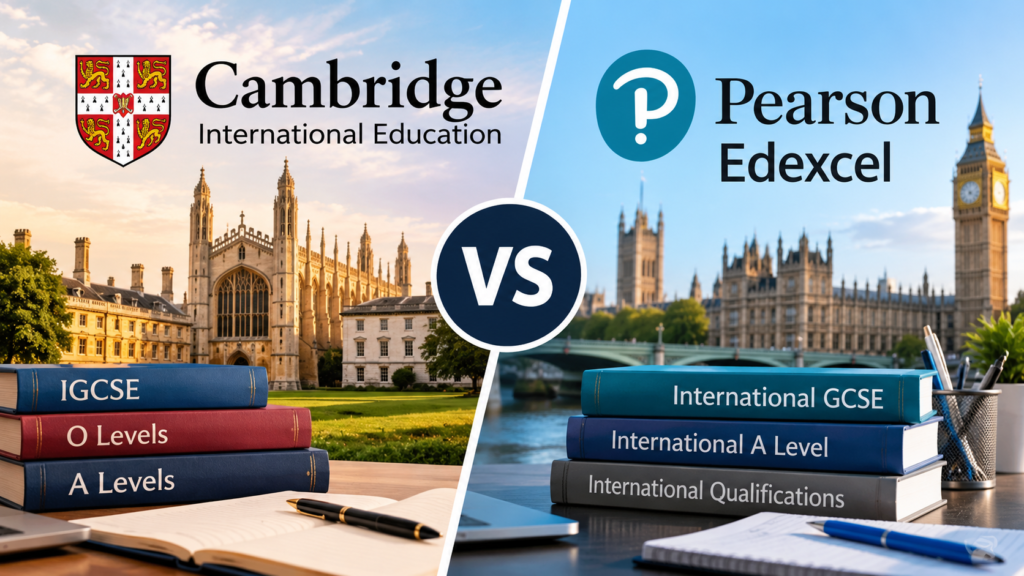
Cambridge vs Edexcel: A Quick Comparison
A practical overview for students and parents in Pakistan. Exact assessment arrangements vary by qualification and subject.
| Feature | Cambridge International | Pearson Edexcel |
|---|---|---|
| Examination provider | Cambridge International Education | Pearson |
| Common qualifications | Cambridge IGCSE, O Levels, International AS and A Levels | International GCSE, International A Levels |
| Subject availability | Broad range of academic and vocational options across its programmes | Broad range of academic and vocational qualifications |
| Assessment methods | May include written examinations, coursework, practicals or other subject-specific components | May include written examinations, coursework, practicals or other subject-specific components |
| Examination opportunities | Depends on qualification, subject and examination series | Some qualifications offer modular assessment; others are linear |
| Grading | Qualification- and subject-specific grading scales | Qualification- and subject-specific grading scales |
| University progression | Subject to university and qualification requirements | Subject to university and qualification requirements |
| Availability in Pakistan | Offered through authorised schools and examination arrangements | Offered through authorised schools and examination arrangements |
The table describes general differences rather than a universal rule for every subject. Always check the current official syllabus and assessment specification before registering for examinations.
What Is Cambridge International Education?

Cambridge International Education is part of the University of Cambridge’s education organisation. It provides international qualifications used by schools in Pakistan and many other countries.
Its well-known qualifications include Cambridge O Levels, Cambridge IGCSE, Cambridge International AS Level, and Cambridge International A Level.
Key features of the Cambridge system
- Subject-based learning: Students choose subjects according to their academic interests and educational plans.
- Different assessment approaches: Depending on the subject, assessment may include written examinations, practical examinations, coursework, or other components.
- Independent understanding: Many subjects require students to apply concepts, interpret information, and solve unfamiliar problems rather than rely entirely on memorisation.
- International progression: Cambridge qualifications may support applications to universities in Pakistan and overseas, subject to each institution’s admission criteria.
Who may benefit from Cambridge?
Cambridge can be a suitable choice for students who prefer structured subject learning, enjoy conceptual understanding, and are comfortable preparing for the assessment methods specified in their chosen subjects.
For example, a student interested in Physics and Mathematics should review the relevant syllabuses, question formats, practical requirements, and past examination papers before selecting subjects.
Parents should not assume that every Cambridge subject is more difficult or more theoretical than its Edexcel equivalent. The actual comparison depends on the specific subjects and qualification levels.
What Is Pearson Edexcel?

Pearson Edexcel is an awarding organisation that offers qualifications in the United Kingdom and internationally. Its international academic programmes include International GCSEs and International A Levels.
Edexcel qualifications are available in subjects such as Mathematics, Biology, Chemistry, Physics, and English, although availability and assessment arrangements differ between qualifications.
Key features of the Edexcel system
- Clearly defined specifications: Each qualification has a published specification describing the subject content and assessment requirements.
- Different assessment structures: Some qualifications use modular examinations, while others are assessed through a linear structure.
- Examination-focused preparation: Students can prepare using the relevant specification, specimen papers, examiner reports, and official past papers where available.
- International progression: Pearson qualifications may be accepted by universities, depending on the programme, grades, subjects, and institution.
Who may benefit from Edexcel?
Edexcel may suit students who prefer its particular syllabus structure, assessment format, or available examination arrangements.
For example, a student who benefits from studying clearly defined units and, where available, taking modular assessments may find a modular qualification attractive. However, not every Edexcel qualification is modular, and students should verify the structure of their exact course.
Parents should compare the actual subject specifications rather than choose Edexcel solely because they have heard that its examinations are easier.
Cambridge vs Edexcel: Which One Is More Difficult?
One of the most common questions parents ask is whether Cambridge or Edexcel is harder. The answer depends on the subject, the qualification, the student’s strengths, and the examination format.
A student may find Cambridge Mathematics more manageable but prefer the question style in Edexcel Biology. Another student may perform well in either system with consistent practice and appropriate teaching.
Consider these factors when comparing difficulty:
1. Syllabus content
Compare the actual syllabus documents for the same subject and level. Look at the topics covered, depth of knowledge required, practical skills, and mathematical demands.
For instance, when comparing Cambridge O Level Physics with Pearson Edexcel International GCSE Physics, review the official specifications side by side rather than relying on general opinions.
2. Examination questions
Review recent past papers and specimen papers for both boards. Pay attention to:
- How questions are worded.
- How many marks are allocated to calculations and explanations.
- Whether students must interpret graphs, diagrams, tables, or experimental results.
- The level of detail expected in written answers.
- How marks are awarded under each mark scheme.
3. Assessment structure
A student who prefers to prepare for one main examination period may prefer a linear assessment route. Someone who benefits from spreading assessments over time may prefer a modular route, where that option is available.
Neither structure automatically makes a qualification easier. Both require students to understand the syllabus and demonstrate the required knowledge.
4. Teaching quality and preparation
The quality of instruction can have a substantial impact on a student’s experience. A teacher who understands the relevant examination board can help the student address knowledge gaps, improve answer structure, and practise the correct examination techniques.
Practical recommendation: Compare two or three past papers for each board before deciding. The paper that initially looks easier is not necessarily the one that best matches the student’s learning needs or future plans.
Cambridge vs Edexcel: Assessment and Examination Patterns
Assessment structure is one of the most useful ways to compare the two boards.
Cambridge assessment
Cambridge IGCSE assessment may include written examinations, oral assessments, coursework, and practical components, depending on the subject. Many subjects use examinations at the end of the course, although the exact arrangements vary.
Students should review the syllabus for their examination year to understand the available components, paper combinations, and assessment objectives.
Edexcel assessment
Pearson Edexcel offers different assessment structures across its international qualifications. Some International GCSE subjects have modular and linear options, while other qualifications follow a specific assessment route.
With a modular qualification, eligible units can be assessed separately. A linear route generally requires students to complete the relevant assessments at the end of the course.
For example, Pearson’s International GCSE science qualifications have offered both modular and linear routes for specified subjects. Availability depends on the qualification, subject, and examination arrangements.
qualifications.pearson.com
+1
Which assessment structure is better?
Use the following comparison to identify what might work best for your child.
| Student preference | What to investigate |
|---|---|
| Prefers one main examination period | Linear assessment options |
| Wants to spread assessments across units | Eligible modular qualifications |
| Learns best through practical activities | Practical and coursework components |
| Needs additional time to develop examination technique | Teaching support, past-paper practice and assessment schedule |
| Is changing schools or examination boards | Subject compatibility, syllabus differences and entry requirements |
Do not choose a board based on assessment structure alone. Check whether the required subjects are available and whether the resulting qualification meets the student’s university and equivalence requirements.
Cambridge vs Edexcel in Pakistan: What Should Parents Know?
For families in Lahore and elsewhere in Pakistan, choosing an examination board involves more than comparing syllabuses. Parents should also consider school availability, examination registration, subject combinations, costs, and the student’s intended next step.
Cambridge O Levels and IGCSE
Cambridge O Levels and IGCSEs are internationally recognised qualifications. In Pakistan, they can be used toward the relevant local qualification equivalence when students meet the applicable requirements.
The Inter Boards Coordination Commission (IBCC) is responsible for equivalence decisions. Requirements may include specified subjects and minimum numbers of passes, depending on the qualification and intended group.
Cambridge International
+1
Pearson Edexcel International GCSEs
Pearson Edexcel International GCSEs are another option for students pursuing an international curriculum. However, parents should confirm the acceptance and equivalence of the exact qualification with the relevant Pakistani authorities and prospective universities.
Do not assume that every combination of international subjects automatically satisfies local equivalence requirements.
Cambridge or Edexcel for Pakistani universities?
Both boards may offer suitable pathways, but admission decisions depend on the university, degree programme, subjects, grades, and applicable equivalence rules.
For competitive fields such as Medicine, Engineering, and Computer Science, check subject prerequisites early. A student planning to apply for a medical degree, for example, should confirm the required science subjects and any additional admission-test or regulatory requirements.
What about Matric and FSc?
Matric and FSc are part of Pakistan’s local education system and may be more practical for families who prefer the domestic curriculum and intend to follow a local academic pathway.
The international route may suit families seeking a different subject structure or considering overseas university applications. However, neither route guarantees admission abroad or within Pakistan.
Parents should compare the full cost, school options, subject requirements, and progression rules before making a decision.
Cambridge vs Edexcel vs Matric and FSc

The following table offers a broad overview of three common routes available to students in Pakistan.
| Factor | Cambridge | Pearson Edexcel | Matric and FSc |
|---|---|---|---|
| Curriculum type | International | International | Pakistani local curriculum |
| Common school qualifications | O Levels, IGCSE, A Levels | International GCSE, International A Levels | SSC, HSSC |
| Assessment | Varies by subject and qualification | Varies by subject and qualification | Varies by board and programme |
| Subject selection | Depends on school and qualification | Depends on school and qualification | Depends on local board and group |
| Local equivalence | IBCC requirements apply | Verify exact qualification and IBCC requirements | Local board qualification |
| Best starting point for a decision | Syllabus and university requirements | Syllabus and university requirements | Local education and career plans |
There is no single best system for every student. A family should consider educational goals, school quality, affordability, and the availability of appropriate academic support.
Which Examination Board Should You Choose?
Instead of selecting a board because friends recommend it, use a structured decision-making process.
Step 1: Identify the student’s future goals
Ask whether the student intends to apply to Pakistani universities, overseas institutions, or both. Identify likely degree programmes and any subject prerequisites.
Step 2: Compare the exact subjects
Review the specifications for each subject the student plans to take. Compare content, practical work, assessment methods, and the number and format of examination papers.
Step 3: Check the school’s provision
A board may look suitable on paper, but the school must be able to offer the student’s required subjects and provide effective teaching.
Ask about subject availability, teacher experience, laboratory facilities, examination registration, and academic support.
Step 4: Review examination resources
Look at official syllabus documents, specimen papers, past papers, and mark schemes. These resources help families understand the nature of the assessment before committing to a route.
Step 5: Confirm equivalence and university acceptance
For Pakistan, consult the IBCC’s current rules and the relevant university’s admission criteria. For overseas applications, review the university’s published requirements for the intended qualification.
Step 6: Evaluate the student’s learning preferences
Consider how the student handles examinations, practical tasks, independent study, and revision. A supportive teacher can help students adapt to the requirements of either board.
How Can a Tutor Help Cambridge and Edexcel Students?
Even a capable student may need additional support when adjusting to an unfamiliar syllabus, learning examination techniques, or preparing for demanding subjects.
A tutor who understands the student’s specific qualification can tailor lessons to the actual syllabus and assessment objectives.
Subject-specific guidance
Students studying Mathematics, Physics, Chemistry, Biology, English, Accounting, or Economics may need different kinds of support. The tutor should understand the subject content and the examination board’s assessment requirements.
Past-paper practice
Past papers can help students recognise question patterns, identify weak areas, and practise working within examination time limits. A good tutor explains mistakes and teaches students how to improve their answers rather than simply providing solutions.
Individual learning plans
Some students need help with foundational concepts, while others understand the content but lose marks because of incomplete explanations or poor time management.
A tutor can assess these needs and plan lessons accordingly.
Home and online tutoring in Lahore
Oxford Home Tutors offers home and online tutoring support for students studying Cambridge, Edexcel, O Levels, A Levels, IGCSE, Matric, and FSc. Families can explore tutoring options based on their child’s subjects, academic level, and preferred learning arrangement.
Visit Oxford Home Tutors to enquire about suitable academic support.
Common Mistakes to Avoid When Choosing an Examination Board
Parents can make a more informed decision by avoiding these common mistakes.
- Choosing based on rumours: Statements such as “Edexcel is always easier” or “Cambridge is always better” oversimplify the differences between subjects and qualifications.
- Ignoring university requirements: A subject combination that seems suitable for school may not meet the requirements of a future degree programme.
- Overlooking equivalence: Students planning to apply to Pakistani universities should confirm the applicable IBCC requirements before finalising their subjects.
- Comparing only examination papers: Syllabus content, teaching quality, practical requirements, assessment arrangements, and school resources also matter.
- Switching boards without reviewing the syllabus: Students changing examination boards may encounter different topics, terminology, assessment objectives, and paper structures.
- Selecting a tutor without checking board experience: A tutor should be familiar with the student’s actual qualification and subject specification, not simply the general subject.
Frequently Asked Questions About Cambridge vs Edexcel:
1. Is Cambridge better than Edexcel?
Neither board is universally better. The right choice depends on the student’s subjects, preferred assessment structure, school provision, academic strengths, and future university plans.
2. Is Edexcel easier than Cambridge?
Not necessarily. Difficulty varies by subject, qualification, and assessment format. Compare the relevant syllabuses, specimen papers, and mark schemes before deciding.
3. Are Cambridge and Edexcel both recognised in Pakistan?
Both awarding organisations offer qualifications that can be considered for equivalence in Pakistan. However, recognition of an awarding body does not automatically establish equivalence for every qualification. Check the current IBCC list of recognised foreign qualification awarding bodies and the requirements for your specific qualification.
4. Can students switch from Cambridge to Edexcel?
A switch may be possible, but students should compare the syllabuses, assessment structures, subject availability, and examination-entry requirements. They should also check whether the new qualification fits their school’s arrangements and future progression plans.
5. Which board is better for studying abroad?
Both Cambridge and Pearson Edexcel qualifications may be accepted by overseas universities. Acceptance depends on the institution, programme, subjects, grades, and any additional admission requirements. Check the requirements of the universities you are considering.
6. Should I hire a tutor for Cambridge or Edexcel examinations?
A tutor can be useful if a student needs help understanding concepts, practising examination questions, improving written answers, or preparing for a particular syllabus. Choose someone familiar with the exact subject and examination board.
Conclusion: Make the Choice Based on Your Child’s Needs
The decision between Cambridge and Edexcel should be based on evidence rather than reputation alone. Both offer established international qualifications, and either may be appropriate depending on the student’s academic goals, preferred learning approach, available school subjects, and future university plans.
For parents in Lahore, the most practical approach is to compare the actual syllabuses, review examination papers, investigate school provision, and confirm IBCC equivalence requirements where relevant.
If your child is already studying O Levels, A Levels, IGCSE, or Edexcel qualifications and needs additional academic support, Oxford Home Tutors can help you explore suitable home and online tutoring options.
Visit Oxford Home Tutors to enquire about tutoring support for Cambridge, Edexcel, Mathematics, Physics, Chemistry, Biology, English, and other school subjects.
External useful resources:
Cambridge International Education
Inter Boards Coordination Commission (IBCC)
Useful internal links:
Cambridge and Edexcel tutors for O Levels and A Levels